Best Free Retrospective Tools Compared (2026)
Picking a retrospective tool shouldn't require a retrospective of its own. But with dozens of options, each marketing themselves as "the best free retro tool," it's hard to know what you're actually getting until you've signed up, invited your team, and hit the first paywall.
We tested seven of the most popular retrospective tools and compared their free tiers, paid plans, and actual feature sets. No sponsored placements, no affiliate deals — just an honest look at what each tool gives you and where it falls short.
Here's what we found.
Quick Comparison Table
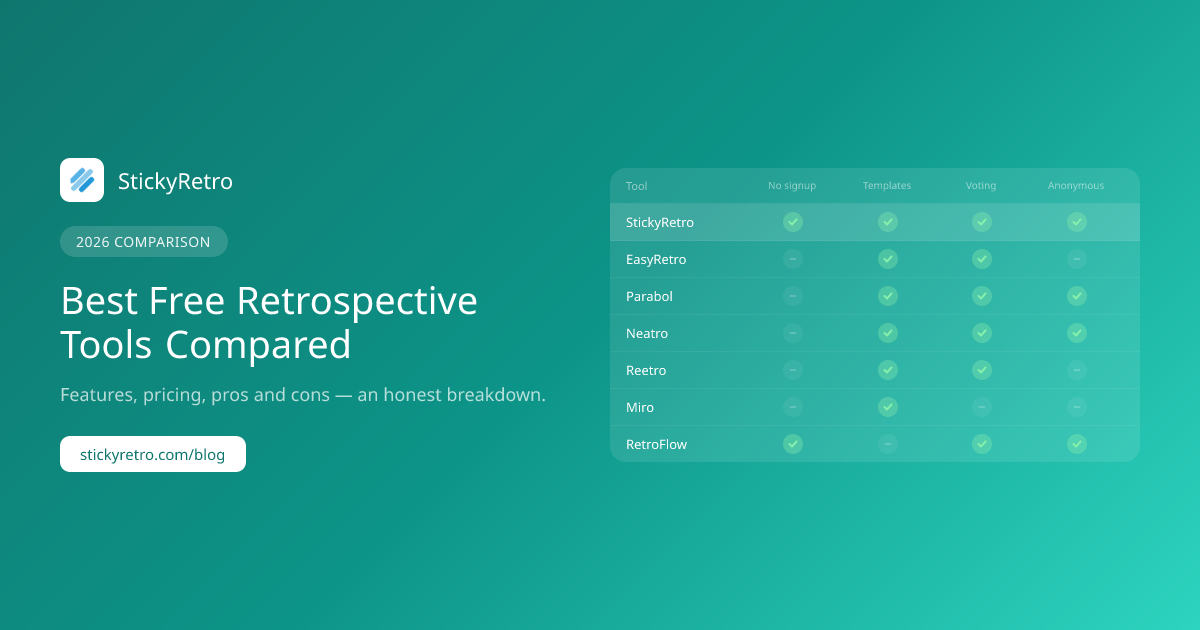
| Tool | Free tier | Signup to join? | Templates | Voting | Anonymous | Paid from | Pricing model |
|---|---|---|---|---|---|---|---|
| StickyRetro | 10 boards, 7-day lifetime | No | 10 built-in | Yes | Yes | $19/mo | Per facilitator |
| EasyRetro | 3 public boards/month | Yes | 100+ | Yes | Yes (paid) | $25/mo | Flat rate |
| Parabol | 2 teams, last 2 meetings | Yes | Yes | Yes | Yes | $8/user/mo | Per active user |
| Neatro | 1 team, 10 members, unlimited retros | Yes | 50+ | Yes | Yes | $23/team/mo | Per team |
| Reetro | 5 teams, 10 boards/month | Yes | 34+ | Yes | Paid only | €27/mo | Flat rate |
| Miro | 3 boards | Yes | Retro templates included | Via stickers | No true anonymity | $8/user/mo | Per user |
| RetroFlow | Unlimited, no limits | No | Basic | Yes | Yes | Free (no paid tier) | Free |
1. StickyRetro
Best for: Teams that want zero setup friction and per-facilitator pricing.
StickyRetro is the tool we built, so take this section with appropriate skepticism. We'll be honest about what it does well and where it has gaps.
What it does well: The main differentiator is speed. Click "Create a free board," get a link, share it. Participants join with no signup, no account, no email confirmation. The board is ready before your meeting starts. This is genuinely useful when you're facilitating a retro with contractors, cross-functional guests, or anyone outside your core team who would otherwise need to create an account they'll use once.
Pricing is per facilitator, not per seat. Your team of 8 doesn't pay 8x — only the person running the retro pays. The free tier gives you 10 boards with a 7-day lifetime, which is enough to run a retro and capture your action items before the board expires.
10 built-in templates cover the most common formats: Start/Stop/Continue, 4Ls, Mad/Sad/Glad, Sailboat, DAKI, KPT, 5 Whys, and others. Real-time collaboration, drag-and-drop, and voting all work as expected.
Where it falls short: The free tier's 7-day board lifetime means you lose historical data unless you upgrade. No Jira or Slack integration yet. No AI features. Fewer templates than tools like EasyRetro or Neatro that have been around longer. If you need enterprise features like SSO, audit logs, or advanced analytics, StickyRetro isn't there yet.
Pricing: Free: 10 boards, 7-day lifetime, no private boards. Pro: $19/mo per facilitator (100 boards, no expiration, private boards, 1 team). Pro+: $49/mo per facilitator (unlimited boards, unlimited teams, custom templates, PDF/Excel export).
Try it: stickyretro.com
2. EasyRetro
Best for: Teams that want a large template library and a familiar, established tool.
EasyRetro (formerly FunRetro) has been around since 2015 and is one of the most recognized names in the space. It's a solid, reliable tool that does the basics well.
What it does well: Over 100 pre-designed templates is the biggest library of any tool on this list. The board interface is clean and intuitive — most teams pick it up immediately without instructions. Customizable boards let you add your own columns, colors, and themes. Integrates with Jira, Slack, and Confluence, which matters for teams that want retro action items to flow into their existing workflow.
Where it falls short: The free tier is limited to 3 public boards per month. That's roughly one retro for one team. If you run biweekly retros, you'll hit the limit in 6 weeks. Public boards mean anyone with the link can see your retro, which may not work for teams discussing sensitive topics. Anonymous feedback requires a paid plan. Participants need to provide their email or sign in.
Pricing: Free: 3 public boards/month, no teams. Paid: $25/mo ($21/mo billed annually). Unlimited boards, private boards, teams, exports.
Website: easyretro.io
3. Parabol
Best for: Teams that want retros, sprint poker, and standups in a single open-source tool.
Parabol is the most feature-rich tool on this list and the only one that's fully open source. It covers five meeting types — retrospectives, sprint poker, standups, check-ins, and team health checks — which means fewer subscriptions if your team uses multiple agile ceremonies.
What it does well: The guided facilitation flow is excellent. It walks you through each retro phase (reflect, group, vote, discuss) with timers and prompts, which is genuinely helpful for new facilitators. AI-generated meeting summaries can post directly to Slack. Integrations with Jira, GitHub, GitLab, Azure DevOps, Slack, and MS Teams. Being open source means you can self-host if your organization has data sovereignty requirements.
Where it falls short: The free plan is limited to 2 teams and only retains the last 2 meetings. That history limit means you can't look back at patterns across sprints. The per-active-user pricing ($8/user/month) gets expensive fast — a 15-person team costs $120/month even if only 10 people speak during the retro. Participants need accounts. The tool bundles a lot of functionality, which adds complexity if all you want is a quick retro board.
Pricing: Free: 2 teams, last 2 meetings history, limited integrations. Team: $8/active user/month. Enterprise: custom pricing.
Website: parabol.co
4. Neatro
Best for: Teams that want structured facilitation with health checks and the most generous free plan limits.
Neatro is a small Canadian team that built a retro tool focused on guided workflows and team health tracking. Their free plan is arguably the most generous on this list for ongoing use.
What it does well: Unlimited retrospectives and team radars (health checks) on the free plan — no board caps, no meeting limits. The 4-step guided workflow (Collect, Group, Vote, Action Plan) keeps retros on track without a skilled facilitator. ROTI (Return on Time Invested) surveys run automatically at the end of every retro, which gives you data on whether retros are actually valuable to the team. The action plan auto-surfaces incomplete items from previous retros, so nothing quietly disappears.
50+ templates including community-contributed formats. Participants can join without creating an account via guest mode. Integrations with Jira, GitHub, Asana, Monday, and Azure DevOps for exporting action items.
Where it falls short: Free plan is limited to 1 team with 10 members. The 30-day report history limit means you lose visibility into older retros. No export functionality on the free tier. No AI features. The interface is clean but opinionated — if you want a freeform board with complete flexibility, Neatro's structured approach may feel restrictive.
Pricing: Free: 1 team, 10 members, unlimited retros, 30-day history. Premium: $23.20/team/month. Pro: custom pricing (adds SSO, advanced security).
Website: neatro.io
5. Reetro
Best for: Organizations managing multiple small teams who want one dashboard for all of them.
Reetro's standout feature is multi-team support in its free tier — you can create up to 5 teams, which is unique among the tools on this list.
What it does well: 5 teams with 10 members each on the free plan gives you broad organizational coverage without paying. AI-powered features include automatic clustering, sentiment analysis, and insights. Built-in health checks, polls, and surveys go beyond standard retro functionality. The action tracker carries items forward across retros. Icebreakers and team-building activities are built in. Integrates with Jira and Confluence.
Where it falls short: Anonymous comments are not available on the free plan — this is a significant limitation for teams that need psychological safety to give honest feedback. 10 boards per month across all teams can feel limiting for organizations with frequent retros. The UI, while functional, feels busier than simpler tools like EasyRetro or StickyRetro. The marketing is quite aggressive, which may or may not reflect your experience with the product.
Pricing: Free: 5 teams, 10 boards/month, 10 members/team, no anonymous mode. Paid: €27/month. Enterprise: custom pricing.
Website: reetro.io
6. Miro
Best for: Teams already using Miro for other collaboration who don't want another tool.
Miro isn't a retrospective tool — it's a general-purpose infinite canvas with retro templates bolted on. That's both its strength and its weakness.
What it does well: If your team already uses Miro for brainstorming, design thinking, or planning, adding a retro board costs nothing extra. 160+ integrations dwarf every dedicated retro tool. AI features help cluster sticky notes and generate summaries. The visual flexibility is unmatched — you can build literally any board layout you want.
Where it falls short: It's overkill for just running retros. The learning curve is steeper than dedicated tools. The free plan limits you to 3 boards. True anonymity doesn't exist — author names are visible once cards are revealed. There's no guided facilitation flow; the facilitator manages everything manually. Per-user pricing ($8/user/month for Starter) means costs scale with team size, not usage.
Pricing: Free: 3 boards, limited features. Starter: $8/user/month. Business: $16/user/month.
Website: miro.com
7. RetroFlow
Best for: Teams that want a completely free tool with zero strings attached.
RetroFlow is the only tool on this list with no paid tier at all. Everything is free, there are no board limits, and no signup is required.
What it does well: It's genuinely free with no catches. No board limits, no team limits, no signup walls. Share a link and everyone joins immediately. Real-time collaboration, voting, and anonymous mode all work on the free plan because there is no paid plan. If your main requirement is "free forever with no limits," RetroFlow is the answer.
Where it falls short: The feature set is basic compared to tools with paid tiers. No templates beyond the default columns. No integrations with Jira, Slack, or other tools. No action item tracking across retros. No team management or organizational features. No guided facilitation. The UI is functional but not polished. Because there's no revenue model, the long-term sustainability is uncertain.
Pricing: Free. That's it.
Website: retroflow.org
So Which One Should You Pick?
There's no single best tool. It depends on what you actually need:
"I just want to run a retro right now with zero friction." StickyRetro or RetroFlow. Both let you create a board and share a link with no signups. StickyRetro has more templates and features; RetroFlow is completely free.
"We run retros every sprint and need history and integrations." Parabol or Neatro. Parabol if you also want sprint poker and standups bundled in. Neatro if you want the most generous free retro limits with guided facilitation.
"We already use Miro for everything." Miro. Don't add another tool if your team lives in Miro already.
"We have multiple teams and need one dashboard." Reetro (free for 5 teams) or Neatro's paid plan.
"We need the biggest template library." EasyRetro with 100+ templates, followed by Neatro with 50+.
"I'm a facilitator and don't want to pay per seat for my whole team." StickyRetro. Per-facilitator pricing means only the person running the retro pays, regardless of team size.
"We need enterprise security and compliance." None of the free tiers. Look at TeamRetro (SOC 2 Type 2), Parabol Enterprise, or Retrium.
One Thing Every Tool Gets Wrong
Every comparison article (including this one) focuses on features and pricing. But the thing that actually determines whether your retros improve is follow-through on action items. The best retro tool is the one your team will use consistently — and that usually means the one with the least friction to start.
Pick one, run a retro this week, and switch later if it doesn't work. The cost of choosing wrong is one hour. The cost of not choosing at all is another sprint of the same problems.
Want to try the zero-friction approach? Create a free board on StickyRetro — one click, no signup for your team, retro-ready in seconds.